
BB Desk
It all started with outrage, memes, and one question posted online late at night.
“What if all cockroaches came together?”
That single line from Abhijeet Dipke, a 30-year-old Boston University graduate hit home snowballing into one of India’s most unusual youth-led political movements in recent memory. Within days, the Cockroach Janta Party, or CJP, transformed from an internet joke into a viral symbol of Gen Z frustration, attracting millions of followers, thousands of volunteers, and eventually protesters on the streets of Delhi.
The movement was sparked by a controversial courtroom remark made by Chief Justice of India Surya Kant during a hearing in May 2026, where unemployed youth were compared to ‘cockroaches’ and ‘parasites.’ Though later clarified, the statement exploded across social media at a time when young Indians were already angry over unemployment, inflation, exam paper leaks, and shrinking opportunities.
Most internet outrage disappears within 24 hours.
Dipke chose to channelize it.
On May 16, he launched the Cockroach Janta Party online, a satirical political platform that embraced the insult instead of rejecting it. The symbolism was sharp and immediate: if the system saw young people as pests surviving in corners, then the ‘cockroaches’ would speak for themselves.
The branding was absurd by design.
The party described itself as “A political front of the youth, by the youth, for the youth. Secular. Socialist. Democratic. Lazy.”
Its membership ‘requirements’ included being unemployed, chronically online, and professionally frustrated. The manifesto mixed satire with genuine anger – mocking political corruption, media theatrics, rigged systems, and the growing disconnect between institutions and young citizens.
But what made the movement explode was not just humor. It was timing.
India’s youth were already carrying years of exhaustion: competitive exams plagued by irregularities, degrees without jobs, endless internships without security, and a political culture that often reduced dissent to memes or anti-nationalism. The Cockroach Janta Party gave that frustration a language people instantly understood.
Within 72 hours, the movement crossed hundreds of thousands of sign-ups. Its Instagram following surged into the millions. Students, unemployed graduates, artists, meme creators, and first-time political participants began reposting cockroach logos and slogans across platforms.
Dipke later admitted that none of it was planned at this scale.
Using AI tools, he rapidly built the party’s website, visual identity, and manifesto almost overnight from the United States, where he was studying public relations.
That digital-first approach became central to the movement’s identity. The Cockroach Janta Party operated less like a traditional political organization and more like an internet-native rebellion powered by reels, sarcasm, livestreams, and viral participation instead of offices or party workers.
Even attempts to suppress it appeared to strengthen it.
When the party’s X account was reportedly withheld in India, Dipke quickly launched a replacement handle called “Cockroach is Back” Supporters treated the ban less as censorship and more as proof that the satire had unsettled powerful institutions.
Soon, the movement began spilling offline.
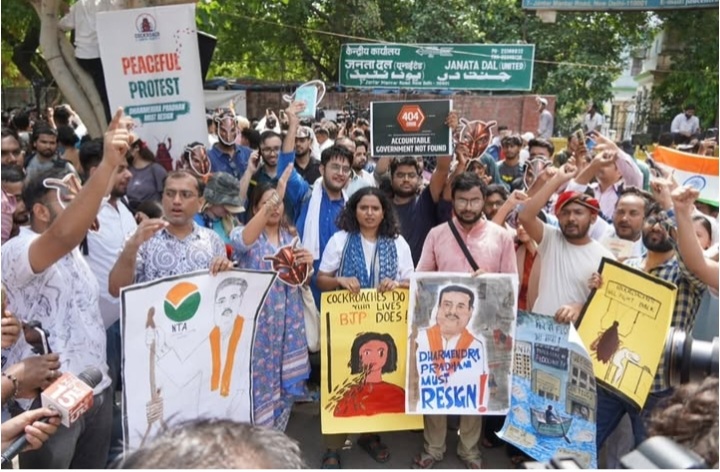
What started as digital campaign evolved into real-world organizing around issues like the NEET paper leak controversy and accountability in education governance. Protest calls spread rapidly through Telegram channels, Instagram stories, and WhatsApp groups with celebrities, political figures, public personalities and influencers openly endorsing the party. On 6th June, the Cockroach Janta Party held its first major protest at Jantar Mantar in New Delhi demanding the resignation of Union Education Minister Dharmendra Pradhan.
The images from the protest captured exactly why the movement resonated:
young people carrying cardboard cockroaches,
students chanting slogans about unemployment,
office workers joining after work,
and volunteers turning satire into political theater.
The protest remained peaceful, but politically significant. It proved that what many dismissed as a meme had become something harder to ignore: a youth movement fueled by humiliation, irony, and economic anxiety.
In interviews afterwards, Dipke insisted the movement was never just about one remark from a judge.
The “cockroach” label, he argued, merely exposed a deeper truth: many young Indians already felt unseen, disposable, and trapped inside systems that only acknowledged them during elections or crisis.
That is why the Cockroach Janta Party spread so quickly.
It did not offer ideology in the traditional sense.
It offered recognition.
And in a political landscape crowded with polished speeches and carefully managed narratives, a movement built on mockery, survival, and collective frustration suddenly felt more honest than anything else online.
