
Sameena Razzaq
The proposed Maharashtra Clinical Establishments (Registration and Regulation) Bill 2026 intended to bring greater uniformity and accountability to Maharashtra’s healthcare sector has triggered concern among sections of the medical fraternity, with doctors warning that its stringent compliance requirements could put small clinics, nursing homes, and neighbourhood dispensaries at risk.
The bill seeks to establish a common regulatory framework for registration, inspection, regulation, penalties, and standardisation of clinical establishments across the state. It also aims to replace the existing Nursing Homes Registration Act, 1949, bringing broad spectrum of healthcare providers across recognised systems of medicine including Allopathy, Unani, Ayurveda, Homoeopathy, Siddha, and Dentistry under one framework.
Its ambit is extensive, covering everything from large multi-speciality hospitals and nursing/ maternity homes to standalone clinics, dispensaries, imaging centres, pathology laboratories, diagnostic centres, and day-care facilities.
Among its key provisions are mandatory registration and inspections, the display of tariffs and services, prescribed minimum standards and penalties for violations. The Bill also mandates clinical establishments to provide ‘Golden Hour’ care, including emergency stabilisation and life support to critical patients, without monetary considerations.
The objective of improving quality, safety, accountability, and transparency in healthcare has not been rejected by the doctors with some widely acknowledging that the intent behind the legislation is legitimate. Their concern, however is with the way the proposed regulatory framework is structured and whether the same set of requirements can realistically be applied to establishments of vastly different sizes, capacities, and areas of practice.
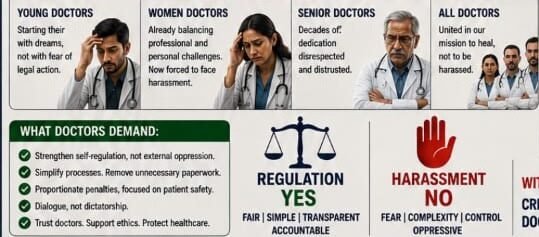
Doctors fear that the bill’s ‘one-size-fits-all’ approach, coupled with extensive registration, licensing, inspection and penalty powers, could turn into what they describe as a ‘Command, Control, Punish’ system including the start of a new ‘Inspector Raj’ and ‘License Raj’ They argue that the resulting compliance burden could make it increasingly difficult for small and medium-sized establishments to survive, particularly those serving low-income communities.
The issue has prompted several medical associations, individual practitioners, nursing homes, and independent healthcare providers to submit suggestions and objections to Public Health Minister Prakash Abitkar and the 21-member Joint Select Committee of both Houses, which has been entrusted with examining the feedback and making recommendations on the Bill.
The Select Committee has so far received around 4,700 suggestions and objections.
‘A sledgehammer approach’
Among those opposing the present form of the legislation is Dr. Tushar Jagtap, convenor of the Healing Hands Unity Panel. Reacting on the representation submitted by the panel to the Select Committee he shares, “This Bill is a sledgehammer approach to healthcare regulation. It’s not possible for a laboratory or imaging centre to provide emergency treatment. Provisions like the ‘Golden Hour’ protocol must be based on clinical competence and scope of practice. The government should not play with people’s lives by introducing legislation without adequate consultation and application of mind. We need trust-based governance, not an arbitrary bureaucratic regime that creates scope for institutionalising corruption. I respectfully urge the government to withdraw the Bill.”
Concerns over cost
Family physicians are deeply worried that increased regulatory requirements could ultimately translate into higher costs for patients.
Dr. Ashok J. Rasalkar, Mumbai branch president of the Federation of Family Physicians’ Associations of India (FFPAI) remarks, “Healthcare cannot be regulated as though every establishment were a five-star hotel. The costs will rise, and the poor patients will suffer. Providing affordable healthcare is fundamentally the government’s responsibility. Instead of strengthening public healthcare, the government appears to be shifting that responsibility onto private doctors. That is neither logical nor fair.”
Small nursing homes fear closure
For smaller establishments, particularly in rural areas, the issue is not merely financial but also practical.
Dr. Jayendra Parulekar, a paediatrician and social activist who runs a 25-bed nursing home in Sawantwadi, Sindhudurg insists the requirements relating to sewage treatment plants, pollution-control compliance, fire and electrical audits, and nursing staff could prove extremely difficult for smaller healthcare establishments to meet. “The government must distinguish between small, medium, and large establishments. You cannot impose the same requirements on a 5- or 10-bed nursing home as you would on a 200-bed hospital. It’s impractical and will force many independent standalone clinics to shut down, paving the way for corporatisation of healthcare,” says Parulekar.
He further adds, “Why are government, BMC, railway and army hospitals excluded from the proposed Clinical Establishments bill? Is this legislation meant only for private doctors? Nearly 72% of Maharashtra’s healthcare is delivered by private practitioners. Yet the Bill imposes disproportionate and impractical requirements on them. This is outright discriminatory.”
‘How can a 100 sq ft clinic handle an emergency?’
Dr. J.K. Rai, an Ayurveda practitioner who operates a 100-square-foot dispensary in a slum area points out, “It’s extremely difficult for me to implement the ‘Golden Hour’ protocol in this small space. Secondly, the Bill says we cannot refuse emergency patients, but how can a small Ayurveda clinic equipped for Panchakarma manage severe bleeding, fractures or other emergencies?”
Drawing attention to how liability would be determined when practitioners attempt emergency interventions he asks, “If we attempt CPR on a critically ill patient and the patient dies, will the doctor be held responsible and penalised?
“The Bill must protect doctors also from harassment and threats by patients’ relatives,” adds Rai.
Dentists raise scope-of-practice issue
Dental practitioners have flagged provisions that could potentially require facilities to respond to emergencies beyond their clinical specialisation.
“Dentists are not equipped or licensed to diagnose and treat medical crises like myocardial infarction or stroke. Forcing them to practise outside their specialised field violates the medical oath – First, do no harm,” contend Dr. Suhail Hakim and Dr. Roshan Khan, dental surgeons at Sharaz Dental Clinic.
Indicating the proposed compliance requirements could badly hit low-cost clinics they shared, “For practitioners operating on razor-thin margins in urban slums, the Bill’s stringent compliance mandates represent an impossible operational shift. It also opens floodgates for bureaucratic harassment, extortion, and systemic bullying over unavoidable medical outcomes. The crippling compliance costs and administrative paperwork will push independent, low-cost clinics out of business transforming primary medical care into luxury and the clinics that do survive, will pass on the burden to patients forcing them to choose between unaffordable private hospitals and overcongested, failing public hospitals.”
Unani practitioners seek strengthening of the existing law
Dr. Nadeem Usmani, convenor of the All India Unani Tibbi Congress suggests, Maharashtra should consider strengthening the existing legal framework.
“Maharashtra already has the Nursing Homes Act, 1949. Instead of repealing it, the government should strengthen and expand it, with clear classifications for small clinics, polyclinics, day-care centres, and nursing homes. I don’t see the need for another Clinical Establishments Act. Moreover, the immediate concern for general practitioners is biomedical waste management. If the government mandates daily disposal, it must first ensure that such services are actually available,” observes Usmani.
Select Committee to mull over suggestions/objections on the bill
The Bill has now moved into the scrutiny process, with the Joint Select Committee expected to consider the large volume of suggestions and objections received from the medical community and other stakeholders.
Addressing the Medical Fraternity’s concerns, Jitendra Awhad, MLA from the Kalwa-Mumbra constituency and a member of the Select Committee revealed the Opposition had in fact prevented the legislation from being passed.
“We opposed this Bill on the floor of the House. Had we not opposed it, the government would have passed it by now. We are against the Inspector Raj that this government is trying to introduce. We are intervening in the matter in the larger public interest, which is precisely why the Bill has been referred to the Select Committee. So far, not a single meeting has taken place. We will consult doctors, specialists, and every stakeholder from the medical field and then incorporate whatever is best for society and in the interest of doctors,” said Awhad.
The debate is no longer about whether healthcare establishments should be regulated, it is about how they should be regulated. For the medical fraternity, the demand is not necessarily an end to regulation, but a framework that recognises differences in size, capacity, clinical scope, and the communities being served.
Despite repeated calls and text messages, Public Health Minister Prakash Abitkar remained unavailable for comment.

