
BB Desk
In a city that rarely complains about gridlocks caused by political rallies, it took one woman—stuck in traffic—to bring everything into sharp focus.
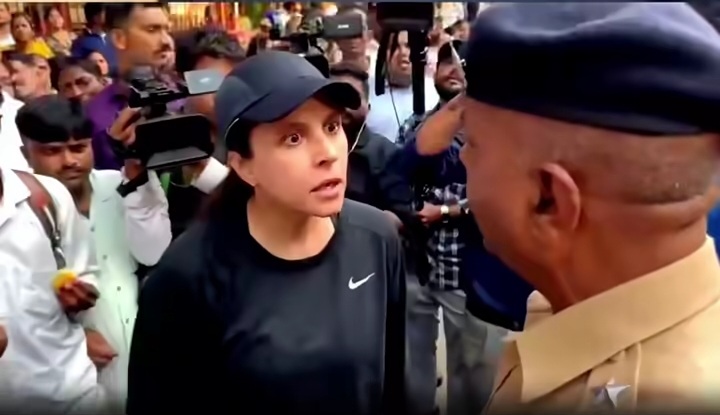
Today, a video from Mumbai went viral, capturing a heated exchange between a commuter and protesters during a political rally in Worli. At the center of it was an unidentified South Mumbai woman who, frustrated after being stranded for over an hour and not able to pick her child from school, stepped out of her vehicle and confronted those she believed were responsible for the chaos—including Maharashtra minister Girish Mahajan.
“Get out of here. Did You not understand. What is wrong with you? There are hundreds of people waiting here,” thundered the woman.
Her words – blunt, piercing and unscripted were instantly relatable – why should ordinary citizens bear the cost of political demonstrations? As she pointed toward an empty ground nearby, she demanded the protest be moved off the road, highlighting a question that resonates deeply in congested urban spaces.
The protest itself, organised by the Bharatiya Janata Party against the opposition over the failure of Women’s Reservation Bill had already caused significant disruption, bringing traffic in the busy Worli area to a standstill. What might have otherwise been another day of gridlock turned into a viral moment because someone chose to speak up.
But the incident is more than just a flash of viral outrage. It reflects a growing tension in modern Indian cities: the clash between democratic expression and everyday life. Protests are a fundamental right, yet when they spill onto arterial roads, they often pit political messaging against the daily struggles of commuters, parents, and workers trying to navigate an already overburdened system.
Social media reactions have been predictably divided. Many hailed the woman as ‘Queen’ and a voice of the common citizen—someone who articulated a frustration millions quietly endure. Others cautioned against oversimplifying the issue, noting that public protest has historically relied on visibility and disruption to be effective.
What makes this moment compelling is not just the confrontation but the shift in public patience, it represents. In a city like Mumbai, where time is currency and delays ripple across lives, the tolerance for traffic blockades appears to be thinning.
The woman at the center of the storm remains unnamed, but her message has traveled far beyond that traffic jam. For a brief moment, she transformed a personal inconvenience into a public conversation—one that forces us to ask – where should the line be drawn in the balance between protest and public inconvenience?
