
BB Desk
India’s real estate growth story is increasingly extending beyond its traditional metropolitan centres with Tier-2 cities emerging as important destinations for homebuyers, investors, and businesses. Bhubaneswar is among the cities gaining prominence, supported by infrastructure development, economic diversification, along with a growing demand for quality residential and commercial spaces.
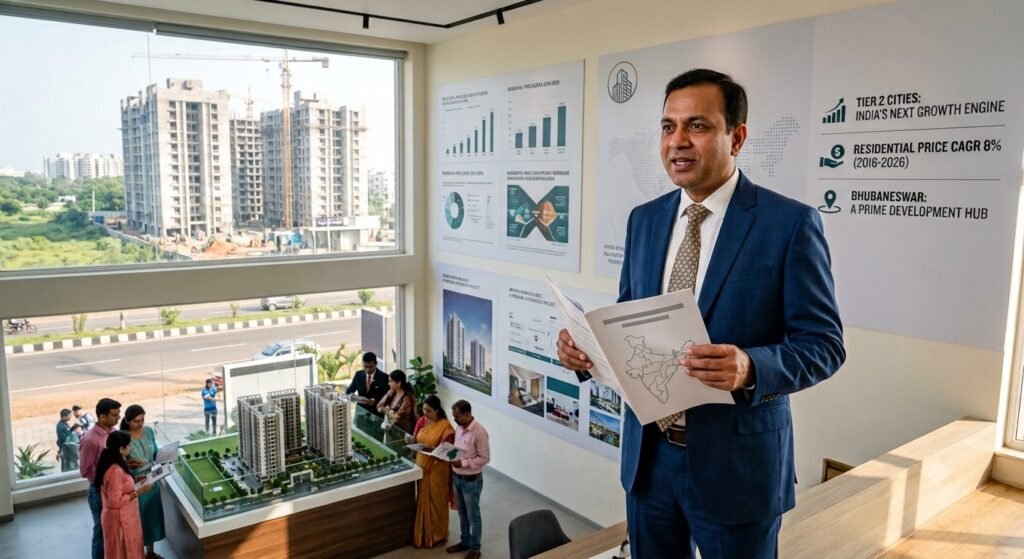
According to India’s Next Real Estate Markets, a joint report by the Confederation of Indian Industry (CII) and Knight Frank India, residential property prices across 11 emerging cities, including Bhubaneswar, Indore, Jaipur, Lucknow, Bhopal and Coimbatore, recorded a compound annual growth rate (CAGR) of 8% between 2016 and 2026. This was twice the 4% CAGR reported across India’s eight leading metropolitan markets during the same period, highlighting the growing significance of smaller urban centres in the country’s real estate landscape.
Bhubaneswar’s residential property prices currently range between ₹6,550 and ₹8,550 per square foot, as per the report. Progressive government policies, improving connectivity, infrastructure investments and a developing micro, small and medium enterprise (MSME) ecosystem are contributing to the city’s growing appeal among residents and investors.
Commenting on the city’s evolution, Rajesh Agarwal, Director, Oriom Group, said, “The CII-Knight Frank report validates what developers on the ground have witnessed over the last few years—the epicentre of India’s growth story is shifting decisively towards Tier-2 cities. Bhubaneswar, with its exceptional blend of modern infrastructure, rapid urbanisation and a high quality of life, has evolved into a mature and highly sought-after real estate destination.”
He added, “Homebuyers and investors today are looking beyond traditional metros, drawn to cities that offer sustainable growth, higher value appreciation and robust economic drivers. At Oriom Group, we are thrilled to be part of this structural transformation through Oriom Realty, delivering world-class residential and commercial spaces that match the aspirations of a progressive Bhubaneswar.”
The city’s residential market is also benefiting from increased interest among end-users and non-resident Odias (NROs). Local property consultants report growing enquiries for gated communities that offer contemporary amenities, landscaped open spaces, and improved lifestyle facilities. Demand across mid-range and premium housing segments is further strengthening Bhubaneswar’s position as a residential destination.
Beyond housing, commercial and industrial development is creating additional momentum. The CII-Knight Frank India report notes that key Tier-2 cities collectively recorded 11.2 million square feet of warehousing and logistics leasing transactions. Bhubaneswar, alongside cities such as Lucknow, Jaipur, Nagpur, Indore and Coimbatore, contributed to a significant share of this activity, with 5.3 million square feet attributed to these markets collectively. Improved multimodal connectivity and strategic investments are helping strengthen the role of emerging cities in India’s logistics and supply-chain networks.
Infrastructure spending is another important driver of this transformation. The share of infrastructure in government capital expenditure rose from 39% in FY2015 to 55% in FY2026, supported by an expanding public-private partnership pipeline. Such investments are helping emerging urban centres improve connectivity, support business activity and create conditions for sustained real estate development.
As India moves towards a projected real estate output of $5.8 trillion by 2047, cities such as Bhubaneswar are expected to play an increasingly important role in meeting the country’s housing, retail, and commercial requirements. With its growing economic base, young population and evolving urban infrastructure, Bhubaneswar is positioning itself not merely as an alternative to established metros, but as a significant contributor to India’s next phase of real estate growth.

