
BB Desk
The internet has a peculiar way of turning a few minutes of conversation into a verdict on someone’s entire life. The recent controversy surrounding Vijay Deverakonda and Rashmika Mandanna following their appearance on Koffee With Karan is a telling example of how quickly public perception can shift, how easily personal relationships become public property, and how social media can blur the line between genuine concern and unnecessary judgement.
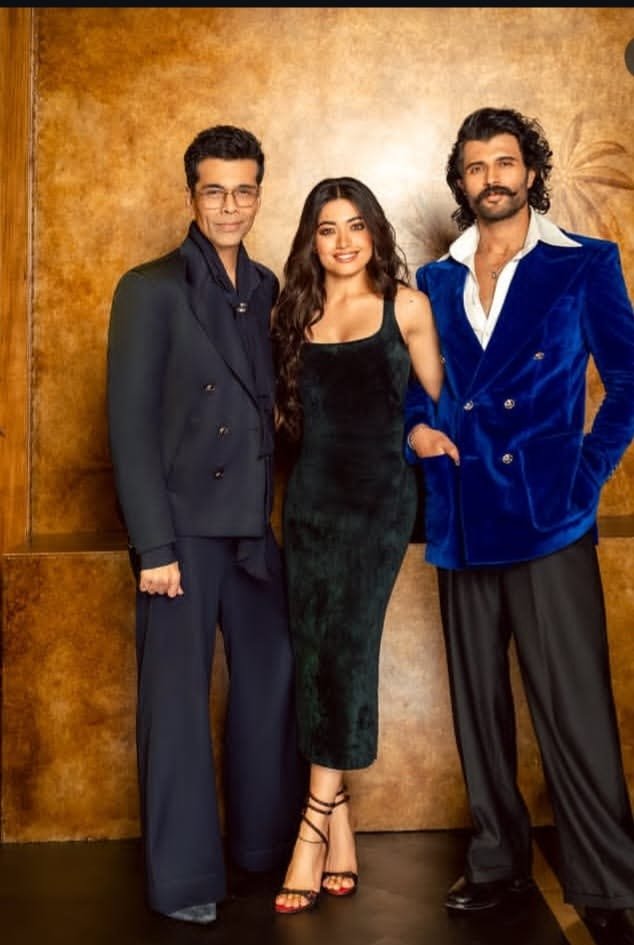
What began as a conversation about marriage and commitment soon became a debate about Vijay’s personality, Rashmika’s choices, and the dynamics of their relationship. Vijay was labelled a red flag, while Rashmika found herself at the receiving end of unsolicited advice, with many questioning why she would accept a partner who in their interpretation had made her wait for commitment.
The reaction raises an important question: how much can we really know about a relationship from a televised conversation?
Vijay’s remarks about taking time to arrive at the decision to marry were interpreted by some viewers as a sign of hesitation, while others viewed them as an indication that he wanted to be certain about a lifelong commitment. The same conversation was received differently depending on the viewer’s understanding of love, marriage, and emotional security. For some, it reflected an imbalance in the relationship. For others, it was simply a couple recounting a personal experience in their own way.
Neither interpretation, however, automatically establishes the reality of their private life.
The more troubling aspect of the controversy was how quickly criticism of Vijay turned into criticism of Rashmika herself. Some people framed their comments as concern for her, while others questioned her judgement and suggested that she deserved better. In doing so, the conversation shifted from examining what was actually said to deciding what Rashmika should feel, whom she should choose, and what kind of relationship she should accept.
There is a difference between discussing relationship dynamics and assuming that a woman is incapable of understanding her own relationship. Concern becomes presumptuous when it leaves no room for her perspective, agency, or lived experience.
Rashmika’s response brought that distinction into focus. By defending her decision and speaking about the support Vijay had offered her, she challenged the narrative that strangers had constructed around their relationship. Her message was not that every criticism was necessarily malicious, but that outsiders did not possess the full context needed to judge a deeply personal decision. She made it clear that she was happy with the life she had chosen and did not need the internet to validate it.
“We’ve been bombarded with opinions, comments, and unsolicited advice unnecessarily. For us, marriage was never about a proposal, getting down on one knee or putting a ring on a finger. For us, it was about building a life and futurte together. And I think we did that beautifully so far. Find Someone you would go to any lengths for, And yes, I am Obsessed with my man. When did that become a bad thing? If I’m not IN LOVE with the man I’m marrying, then why in the world would I marry him? I’d do it a thousand times — 100 is nothing. It’s really that simple.” wrote Rashmika in her lengthy post on Instagram.
Vijay, meanwhile, responded with humour before making his support for Rashmika explicit. “My best friend, my wife, my woman, one of the most beautiful parts of my life that I got absolutely right. For all those concerned, We are both gloriously happy. I am blessed. If its me and her against the world- so be it” posted Vijay. His reaction suggested that he was unwilling to let online commentary define their marriage. While his approach may not persuade everyone who found his earlier remarks uncomfortable, it underscored a point that often gets lost in celebrity controversies: public opinion does not automatically become the truth simply because it is repeated often enough.
Social media tends to reward certainty over nuance. A complicated conversation is reduced to a label; a relationship becomes a collection of supposedly incriminating moments; and a person is judged not by the entirety of their actions but by the most controversial interpretation of a few sentences. Once a narrative takes hold, every subsequent action can be interpreted as evidence in its favour. Even a couple’s response to criticism becomes another opportunity for scrutiny.
Perhaps the most revealing part of this episode is not whether Vijay is a red flag or whether Rashmika’s choices meet the expectations of strangers. It is how readily the internet assumes the authority to make those decisions for them.
A healthy relationship cannot be assessed through a single universal timeline. Taking time to commit is not inherently a warning sign, just as being deeply in love is not, by itself, proof that a relationship is healthy. What matters is the broader pattern of respect, honesty, mutual understanding and the freedom both people have to make their own choices. Those are things a short television appearance can rarely establish conclusively.
Ultimately, Vijay and Rashmika are entitled to define their relationship on their own terms. Their public statements do not require everyone to agree with them, nor do they settle every question raised by the interview. They do, however, remind us that the people living a relationship have access to a context that audiences watching from the outside do not.
The internet can question, discuss, and disagree but What it should be more cautious about is turning limited information into absolute judgement.
