
BB Desk
The controversy surrounding Chief Election Commissioner Gyanesh Kumar has moved beyond the familiar political allegations against the Election Commission of India (ECI). The immediate trigger is a report by The Indian Express that Election Commissioners Sukhbir Singh Sandhu and Vivek Joshi recorded objections on at least 14 occasions over roughly ten months concerning decisions and administrative actions within the poll panel. The controversy has now acquired a second dimension: questions about whether the ECI’s internal decision-making is sufficiently transparent and genuinely collective.
The development is particularly significant because the ECI is a constitutional institution whose legitimacy depends not merely on the formal legality of its decisions, but also on public confidence in the neutrality, transparency, and institutional independence of the electoral process.
What triggered the controversy?
The dispute emerged because of the alleged arbitrary conduct of the Special Intensive Revision (SIR) of electoral rolls. The exercise began in Bihar in 2025 and subsequently expanded. According to The Indian Express, more than 13 crore names had been struck off draft electoral rolls across 30 States and Union Territories, making the process one of the most consequential exercises undertaken by the ECI in recent years.
The newspaper’s investigation reported that Sandhu and Joshi had objected to several actions concerning electoral-roll management, including changes relating to Form 6, the addition and deletion of voters, access to electoral databases and aspects of the administration of the Commission. They reportedly also raised concerns about the increasing centralisation of the electoral database and the functioning of the systems through which electoral-roll information is managed.
The critical issue, therefore, is not simply that commissioners disagreed. Disagreement within a constitutional body is neither unusual nor necessarily problematic. The more consequential question is whether the objections represented ordinary internal deliberation or evidence that important decisions were being taken without the meaningful participation of all three commissioners. That distinction matters enormously.
The ECI’s defence
The Election Commission has rejected the interpretation that the reported objections demonstrate a breakdown of the Commission’s decision-making.
Its position is that written observations, technical suggestions and internal checks and balances are normal components of institutional deliberation. The Commission has maintained that all final decisions, including decisions concerning SIR, were unanimous and approved by the CEC and both Election Commissioners.
Why Gyanesh Kumar has become the focus
Kumar became Chief Election Commissioner in February 2025, after serving as an Election Commissioner from March 2024. The Indian Express has highlighted that he is the first CEC appointed under the 2023 law that changed the composition of the committee selecting Election Commissioners. Under that framework, the government has a greater role in the selection process than under the earlier arrangement.
His tenure has also coincided with intense political controversy over SIR. Opposition parties have repeatedly questioned the timing, methodology and consequences of electoral-roll revisions and have accused the ECI of acting in a manner favourable to the ruling establishment. Those are political allegations, however, and Kumar and the ECI have rejected claims of partisan conduct.
The new element supplied by the Indian Express investigation is that the criticism is no longer based solely on the Opposition’s political claims. It points to internal documentation from serving members of the Commission itself.
That does not automatically validate the Opposition’s interpretation, but it makes the institutional questions more difficult to dismiss as merely partisan rhetoric.
Enter the Cockroach Janata Party
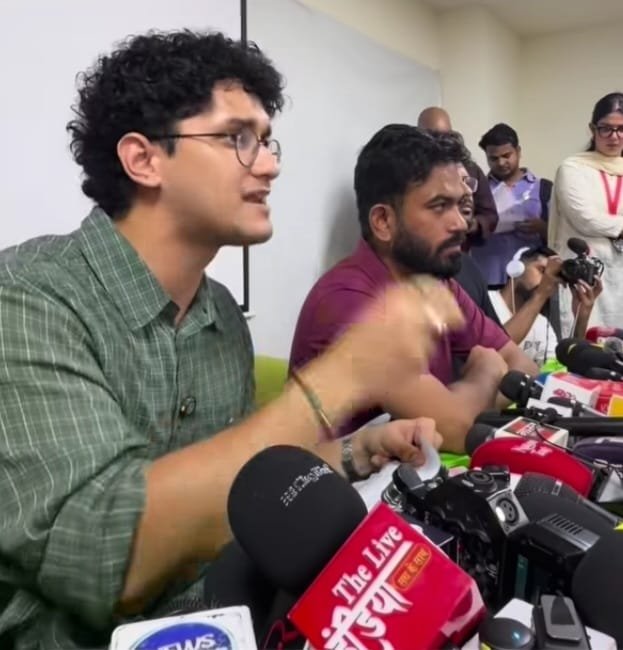
Against this backdrop, the Cockroach Janata Party (CJP) held a press conference in New Delhi on September 24, turning the controversy into a direct political campaign against the CEC.
CJP founder and convenor Abhijeet Dipke gave Gyanesh Kumar 48 hours to resign, warning that failure to do so would trigger a nationwide agitation. Dipke referred to the proposed mobilisation as ‘Jantar Mantar 2.0.’
The timing was significant. CJP’s intervention came immediately after the publication of the Indian Express investigation and amid a broader Opposition campaign demanding accountability from the Election Commission. The party was therefore attempting to convert an institutional controversy into a public mobilisation issue.
CJP’s rhetoric was considerably stronger than the language used by the ECI itself. Dipke questioned the legitimacy of the electoral-roll exercise and alleged that the Commission was effectively determining who could exercise the right to vote.
CJP’s three demands
At the press conference, CJP co-convenor Saurav Das/Ashutosh Ranka outlined the party’s demands. Reporting varies slightly in how the demands are grouped, but their substance can be summarised as follows:
- Resignation and criminal proceedings against Gyanesh Kumar
CJP demanded Kumar’s resignation and called for criminal proceedings against him, alongside disclosure of anyone who allegedly directed the decisions at issue - Freeze electoral exercises and restore the pre-SIR rolls
The party demanded that ongoing electoral exercises including SIR be halted and that the electoral rolls be restored to their pre-SIR status. It also called for an independent inquiry into the SIR process, with relevant files placed under the custody of a Supreme Court-led or court-supervised mechanism. - Repeal the 2023 appointment law and create a new framework
CJP called for repeal of the 2023 law governing the appointment of the CEC and Election Commissioners and sought a new appointment mechanism involving wider civil-society participation.
CJP also called for a halt to forthcoming elections as part of its broader demand for electoral-system intervention.
Ultimately, the significance of these events will depend less on the arguments of either side than on what the documentary record, independent investigation, and courts establish about how decisions were actually made inside the Election Commission. That is the question on which the credibility of the institution and public confidence in the electoral process will turn.

