
BB Desk
In an increasingly competitive hiring environment, businesses are realising that competitive salaries and hybrid work policies alone are no longer enough to secure and retain top talent. The quality of the workplace itself has become a defining factor in employee satisfaction, productivity and long-term engagement. As organisations place greater emphasis on employee well-being, healthier and more sustainable office environments are emerging as a key driver of business performance and a major influence on the evolution of India’s commercial real estate sector.
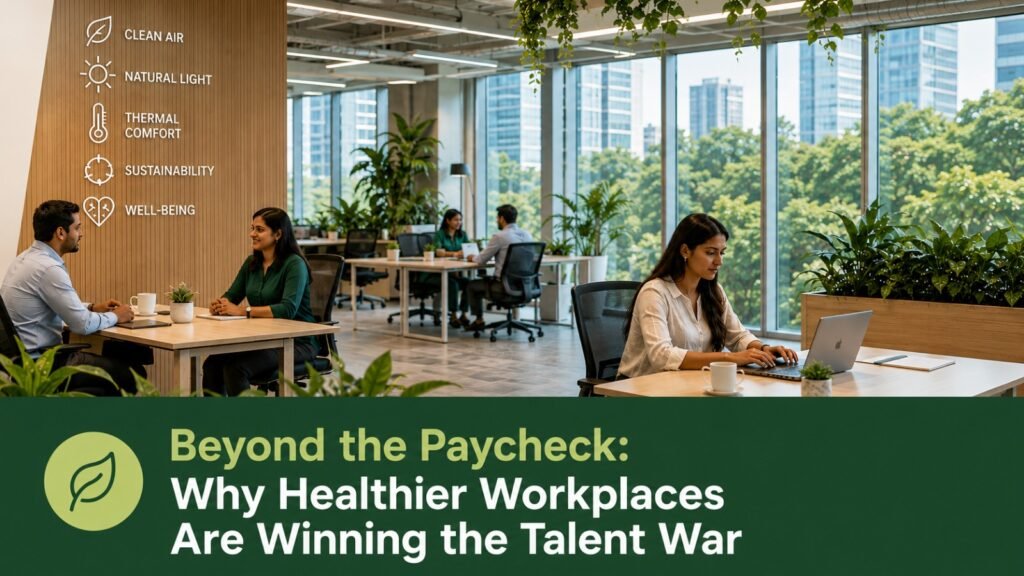
The pandemic fundamentally changed the way employees perceive the workplace. Today, professionals expect offices to contribute positively to their physical and mental well-being rather than simply function as places of work. As a result, features such as superior indoor air quality, efficient ventilation, abundant natural light, thermal comfort and sustainable design have moved from being value-added amenities to essential workplace requirements. This shift is encouraging developers and occupiers alike to prioritise environments that support healthier and more productive work experiences.
Research increasingly supports this transition. According to the World Green Building Council, improved indoor air quality and enhanced ventilation can increase workplace productivity by 8–11 per cent. Similarly, a study by the Harvard T.H. Chan School of Public Health found that employees working in high-performance, well-ventilated buildings recorded significantly higher cognitive function scores compared to those in conventional office spaces. These findings reinforce the growing understanding that healthier indoor environments contribute directly to improved concentration, decision-making and overall workplace performance.
Commenting on this shift, Shilpin Tater Managing Director of Superb Realty stated, “The definition of a premium workplace has evolved significantly. Today, organisations evaluate office spaces not only on location or operational efficiency but also on their ability to support employee health, engagement and productivity. As workplaces become an integral part of a company’s talent strategy, factors such as indoor air quality, ventilation, thermal comfort and access to healthier environments are playing a vital role in enhancing employee well-being.”
He further added, “At Superb Realty, we believe sustainability and wellness are inseparable. Features including advanced air purification systems, low-emission construction materials, intelligent ventilation and real-time air quality monitoring are becoming fundamental elements of future-ready office developments. As businesses compete for talent, healthier workplaces will increasingly influence productivity, employee retention and long-term organisational resilience.”
This evolving mindset is also accelerating demand for green-certified office developments. Organisations are increasingly seeking workplaces that not only align with their environmental, social and governance (ESG) objectives but also create healthier and more engaging environments for employees. Sustainable buildings deliver benefits beyond reduced environmental impact by improving comfort, enhancing employee satisfaction and supporting stronger business outcomes.
Sharing a similar perspective, Shraddha Kedia Agarwal, Director, Transcon Developers observed, “Today’s workplace is much more than a functional office; it reflects an organisation’s culture, values and commitment to its people. Employees are increasingly evaluating workplaces based on wellness, sustainability, flexibility and the overall experience they provide. As competition for skilled professionals intensifies, office environments that encourage collaboration, well-being and engagement are becoming an important differentiator for employers.”
Industry experts also point to growing evidence that workplace wellness has a measurable impact on business performance. Global research consistently indicates that healthier indoor environments can improve concentration, reduce fatigue and enhance overall employee satisfaction. Consequently, the workplace is emerging as a valuable extension of an organisation’s employer brand, influencing not only recruitment but also employee loyalty and retention.
Highlighting another emerging standpoint, Jayesh Rathod, Co-Founder & Director, The Guardians Real Estate Advisory shared, “Rising temperatures, declining outdoor air quality and increasing climate uncertainty are making employees more conscious of the indoor environments where they spend most of their day. Businesses are therefore looking beyond conventional office infrastructure and prioritising developments that offer cleaner air, improved thermal comfort, and greater resilience against external environmental conditions. As climate-related challenges continue to intensify, healthier workplaces will become increasingly important in supporting employee well-being, sustaining productivity and ensuring long-term business continuity.”
His observations underscore a broader transformation taking place across India’s commercial real estate landscape, where employee wellness, sustainability, and climate resilience are becoming closely interconnected.
As the future of work continues to evolve, the workplace is no longer merely a physical location but a strategic business asset. Organisations and developers that successfully integrate wellness, sustainability and intelligent building technologies into their office spaces are setting new benchmarks for the sector. In the competition for talent, healthier workplaces are rapidly emerging as one of the strongest differentiators, creating environments where both employees and businesses are positioned to thrive.
